
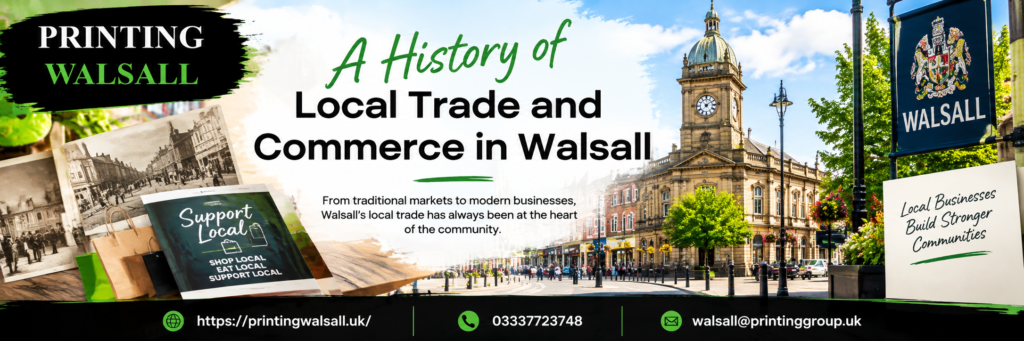
Walsall has a long connection with trade, manufacturing and local enterprise. Its position in the West Midlands and its industrial past have helped shape the town’s economy, streets and business community. Leather working became particularly important to Walsall, while metalworking and other manufacturing trades also provided work and supported related businesses.
The local economy has changed considerably over time. Manufacturing remains part of Walsall’s identity, but the town now also supports retailers, professional services, hospitality businesses, tradespeople and community organisations. Shopping areas, industrial estates and transport connections all contribute to commercial activity.
For local companies such as printing walsall, understanding this history provides useful context. Printed materials have long supported commerce, whether through signs, notices, catalogues or business stationery. Today, businesses still use print alongside websites, email and social media to communicate with customers.
Walsall’s Growth as a Trading Town
Walsall developed as a market town before industrial growth changed its economy. Markets provided a practical place for local people to buy and sell goods, bringing traders and customers together in the town centre.
As Walsall grew, its position within the wider Black Country became increasingly important. The surrounding region developed a strong manufacturing economy, with workshops, factories and supporting trades creating employment and commercial opportunities.
The town centre continued to play an important role as commerce developed. Retailers, service providers and market traders needed ways to make their businesses visible. Signs, handbills, notices and other printed items were practical tools for communicating prices, products and services.
The same basic need continues today. A new shop may use flyer printing to introduce itself to nearby residents, while an established business may require business card printing for meetings and local contacts. The methods have changed, but clear communication remains part of everyday trade.
Leather and Manufacturing in Walsall
Leather working is one of the best-known parts of Walsall’s industrial history. The town became closely associated with the production of saddles, harnesses and related leather goods. This history is represented today by Walsall Leather Museum, which helps visitors understand the skills and working methods connected with the local leather industry.
Manufacturing also supported a wider network of suppliers, workshops, transport businesses and traders. A factory did not operate on its own. It needed materials, workers, equipment and customers. This created opportunities for other businesses throughout Walsall and the surrounding Black Country.
Although the local economy has become more varied, industrial and commercial areas are still important. Places such as the Green Lane area and parts of Pleck accommodate businesses that operate away from the main retail centre.
Modern manufacturers and trade businesses also need practical marketing and workplace materials. Brochure printing and booklet printing can be useful for product information and technical details, while workwear printing can help staff working on-site, making teams easier to identify.
The Changing Role of Walsall Town Centre
Walsall town centre has remained an important commercial focus even as shopping habits have changed. The market, shops and services around the central area bring together independent traders, larger retailers, food businesses and organisations serving local residents.
The Saddlers Shopping Centre forms part of the town’s retail environment and is closely connected with Walsall railway station. This combination of shopping and transport helps bring people into the centre from surrounding areas.
Modern town-centre businesses face different challenges from earlier generations of traders. Customers now discover businesses through online searches and social media as well as by walking past a shop. Physical visibility, however, still matters.
Poster printing can support promotions in windows and indoor spaces, while leaflet printing can help businesses communicate with customers beyond their premises. Restaurants, shops, salons, charities and local service providers can also use banners or other large format printing for openings, events and temporary promotions.
Print works best when it provides useful information rather than simply filling available space. Opening times, contact details, event dates, directions and clear offers are often more useful than complicated designs.
Transport and Walsall’s Commercial Connections
Transport has always influenced local trade. Modern Walsall has road and rail connections with Birmingham and other parts of the West Midlands, helping residents travel for work and allowing businesses to serve customers across a wider area.
Walsall railway station provides services towards Birmingham, while the town’s road network connects with major routes including the M6. These links are useful for businesses moving products, receiving supplies or meeting customers elsewhere in the region.
Good transport connections have also helped commercial and industrial areas develop outside the traditional town centre. Businesses are spread across different parts of the borough, meaning marketing often needs to reach more than one local audience.
For a business serving customers across Walsall, printed materials can support this wider reach. Flyers and leaflets can be distributed in selected areas, while banners and posters can support events or premises where passing traffic and visitors are important.
Same day printing may also have a practical role when a local business has an urgent event, meeting or last-minute change. It can be useful for replacing damaged materials or preparing updated information without waiting for a longer production schedule.
Local Events, Culture and Community Commerce
Trade in Walsall is not limited to shops and industrial businesses. Community organisations, schools, sports groups, charities and event organisers all contribute to local activity.
Cultural venues such as The New Art Gallery Walsall and Walsall Leather Museum attract residents and visitors, while community venues across the borough host meetings, activities and events. These organisations create opportunities for nearby food businesses, retailers, transport providers and other local services.
Events also create short periods when clear local communication becomes particularly important. Organisers may require programmes, posters, directional signs or banners. Community groups may use leaflet printing to provide information, while local businesses taking part in an event may need business cards, brochures or printed clothing.
T shirt printing can be useful for event teams, clubs and volunteers because it provides a simple way to identify people working at an activity. Large format printing can also support signs and displays that need to be read from a greater distance.
These uses show how printed communication continues to support local commerce even though the wider marketing environment has changed.
From Traditional Trade to Modern Walsall Businesses
Walsall’s economy today is much broader than the industries for which the town first became well known. Manufacturing continues, but it sits alongside retail, construction, professional services, hospitality, education, healthcare and many small independent businesses.
Modern companies have more ways to communicate than businesses of the past. Websites, online advertising and social media can reach customers quickly, but physical materials remain useful in local settings.
Printing services in Walsall can support different stages of business activity. A start-up may need business cards and flyers. A retailer might use posters for an in-store promotion. A manufacturer could require brochures, workwear and large format displays. A community organisation might need leaflets and banners for a local campaign.
The important point is to choose materials according to their purpose. Local businesses do not need every type of print product. They need clear information presented in a format that suits their customers, location and activity.
Conclusion
Walsall’s commercial history has been shaped by markets, leather working, manufacturing, retail and its connections with the wider West Midlands. While the types of businesses operating in the area have changed, local trade continues to depend on businesses being able to communicate clearly with customers and the wider community.
Today’s Walsall includes traditional industrial areas, town-centre shops, independent businesses, service providers and community organisations. Each contributes in a different way to the local economy.
Printing has also changed alongside local commerce. From basic trade notices and business stationery to brochures, posters, workwear and banners, printed communication continues to have a practical place. For Walsall businesses, it remains one of several useful ways to build a visible presence and provide customers with clear information.